
Tests all smoke fire detectors
Smoke Detector Test Spray
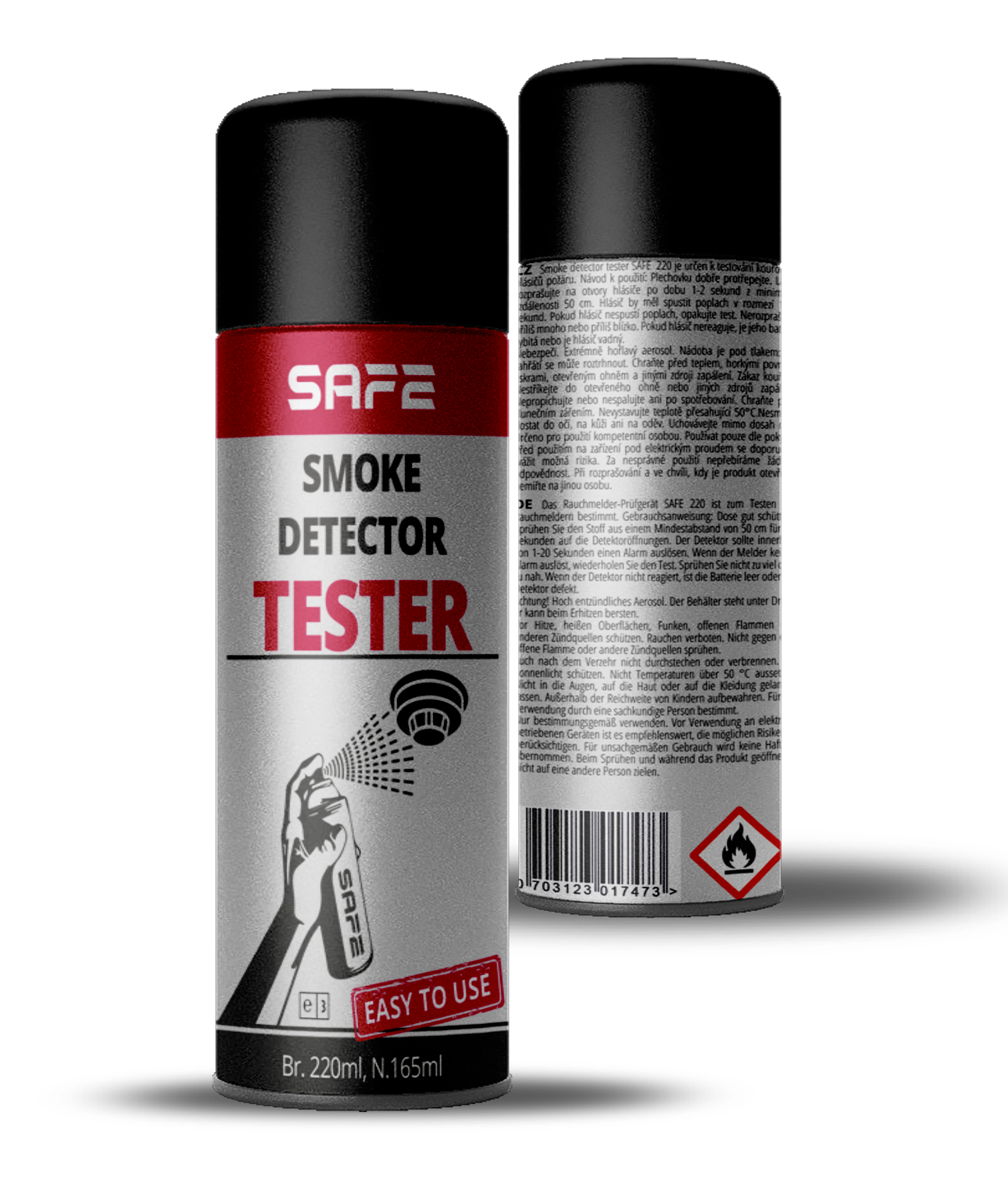
SAFE 220
The test button on smoke fire detectors does not serve to check the sensor itself, but only verifies the status of the power batteries, the functionality of electronic circuits, and the correct activation of acoustic and optical signaling. Because the lifespan of sensors in fire detectors can vary and is often unpredictable, manufacturers recommend regularly verifying their proper function using a special calibrated aerosol that faithfully simulates the presence of smoke. If you have purchased a smoke detector to protect yourself and your loved ones, we recommend performing a sensor check using SAFE 220 test gas every six months. Only this way will you gain the certainty that your detector truly fulfills its life-saving role and will alert you in time in case of danger.
Description of the Device
It Will Verify That Your Fire and Smoke Detector Is Working Properly
Thanks to the specially developed composition of aerosol particles in the SAFE 220 test spray, it is possible to faithfully simulate a wide spectrum of actual fire symptoms. This gives you the assurance that your smoke detectors will respond immediately and reliably to any type of fire. Testing is carried out using an aerosol application, whose unique composition was designed to safely simulate smoke particles from fire. In this way, it is possible to verify that fire detectors respond correctly to various fire scenarios. This is the most widespread professional method that is globally recognized and recommended by leading fire alarm manufacturers such as Kidde, SAFE, FireAngel, Honeywell, or Ajax.
Method of Activating the Test Spray
The test spray is made of a seamless cylindrical container manufactured from high-quality drawn aluminum, which ensures high resistance and long service life. The surface of the container is fitted with a durable label containing textual and graphical information, including instructions for use and supplementary information. The upper part of the container has a conical termination, in which a valve is firmly installed, followed by a plastic atomizer. By simply pressing the atomizer, the spray is activated and the test aerosol is released. To protect the atomizer from contaminants and mechanical damage, the spray is equipped with a removable cover made of durable plastic. The total duration of gas flow is approximately 75 seconds.
Rules For Testing
Testing is very easy and does not require any special tools. Before use, shake the spray thoroughly and then briefly (1–2 seconds) direct the aerosol towards the sensor inlet openings of the detector from a minimum distance of 50 cm. The detector should trigger an alarm within 1 to 20 seconds. If this does not happen, repeat the test. Make sure you do not use too much test aerosol and do not spray it too close to the detector. If even a repeated test does not trigger an alarm, check the battery status or consider replacing the detector, as it may be malfunctioning.
Economical and Safe
The composition of the SAFE 220 test gas aerosol is completely safe and gentle on your device. It does not cause corrosion, does not damage the plastic parts of the detector, leaves no stains, and does not contaminate the detection chambers in any way. When used correctly according to the attached instructions, it poses no health risk to humans or pets. You can therefore use it with complete peace of mind, knowing that your device and health will remain safe.
Simply effective and Eay to Apply
SAFE 220 test spray is an indispensable tool not only for professionals – service and fire technicians, chimney sweeps, or companies specializing in the installation of fire and smoke detectors – but also for private users and owners of all types of smoke detectors. Anyone who wants to be sure that their devices work reliably and provide effective protection against this life-threatening hazard will appreciate the simplicity and effectiveness of this spray. You can thus always keep the safety of your home and work environment under control.
Technical Specifications
- Model
- Testing kit for
- Test Execution
- Gas Dosing Time
- Capacity
- Volume
- Operating Temperature
- Operating Humidity
- Storage Conditions
- Product Weight
- Product Dimensions
- Quantity per carton
- Carton Dimensions
- Weight of the carton
- Environment
- UN number
- Certification
- Tested
- EAN code